Client
Staking Rewards
Year
2025
Industry
Digital Assets & Financial Infrastructure
Staking Rewards is a live product platform that provides structured insight into staking, yield, and validator performance across a wide range of proof-of-stake networks. The platform serves a broad audience, from individual participants to institutional allocators, all operating in environments where clarity, accuracy, and trust are essential. My work focused on leading product and brand design within an active, data-driven system.
This included improving how complex staking concepts are communicated, designing interfaces that support comparison and evaluation, and building design systems that could scale as the platform, data surface, and user needs evolved. A key challenge was translating dense, protocol-level data into interfaces that remain understandable without oversimplifying the underlying mechanics. This required close alignment between product design, data structures, and engineering constraints, ensuring that design decisions were grounded in how the platform actually functions rather than how it appears in isolation. Beyond individual features, the work emphasized long-term structure. Design systems, CMS-driven components, and internal workflows were developed to support ongoing iteration without fragmentation.
PROBLEM
Shifting scope
Staking Rewards evolved rapidly over a short period of time, expanding from a data aggregation platform into verification, marketplaces, staking applications, yield products, and protocol ratings. Each step responded to real market demand, but the pace of expansion strained the original product framing. Without a clear structural identity, the platform risked being perceived as a collection of adjacent tools rather than a coherent system. Users increasingly needed to understand not just what Staking Rewards offered, but what it fundamentally was.
Complexity growth
As new product surfaces were introduced, the volume and density of information grew significantly. Metrics, yields, providers, risks, and mechanisms accumulated across the platform, raising the cognitive burden on users. The challenge was not access to data, but interpretation. Without careful structure, comparison and decision-making became harder as the platform expanded, especially for users operating across multiple networks and strategies.
Credibility pressure
With the introduction of Verified Staking Providers, ratings, and yield products, Staking Rewards moved into a position of implicit authority. Users were no longer just consuming data, but relying on the platform to inform high-stakes decisions involving capital allocation and risk. This shift raised the bar for clarity, consistency, and neutrality. Any ambiguity in presentation or methodology risked undermining trust, even if the underlying data was sound.
System cohesion
As the platform grew in scope and ambition, design decisions increasingly needed to scale across products, teams, and tooling. Early patterns that worked for a single data product no longer held across marketplaces, apps, and protocols. Without shared systems and principles, the risk was fragmentation, duplicated effort, and erosion of coherence across the user experience. Design needed to operate as connective tissue rather than surface polish.
VIEWS


Responsiveness was treated as a structural requirement rather than an afterthought. Layout logic, hierarchy, and interaction patterns were designed to hold consistently across screen sizes, ensuring that decision-making remains coherent whether accessed on desktop or mobile. The goal was continuity of reasoning, not visual parity.
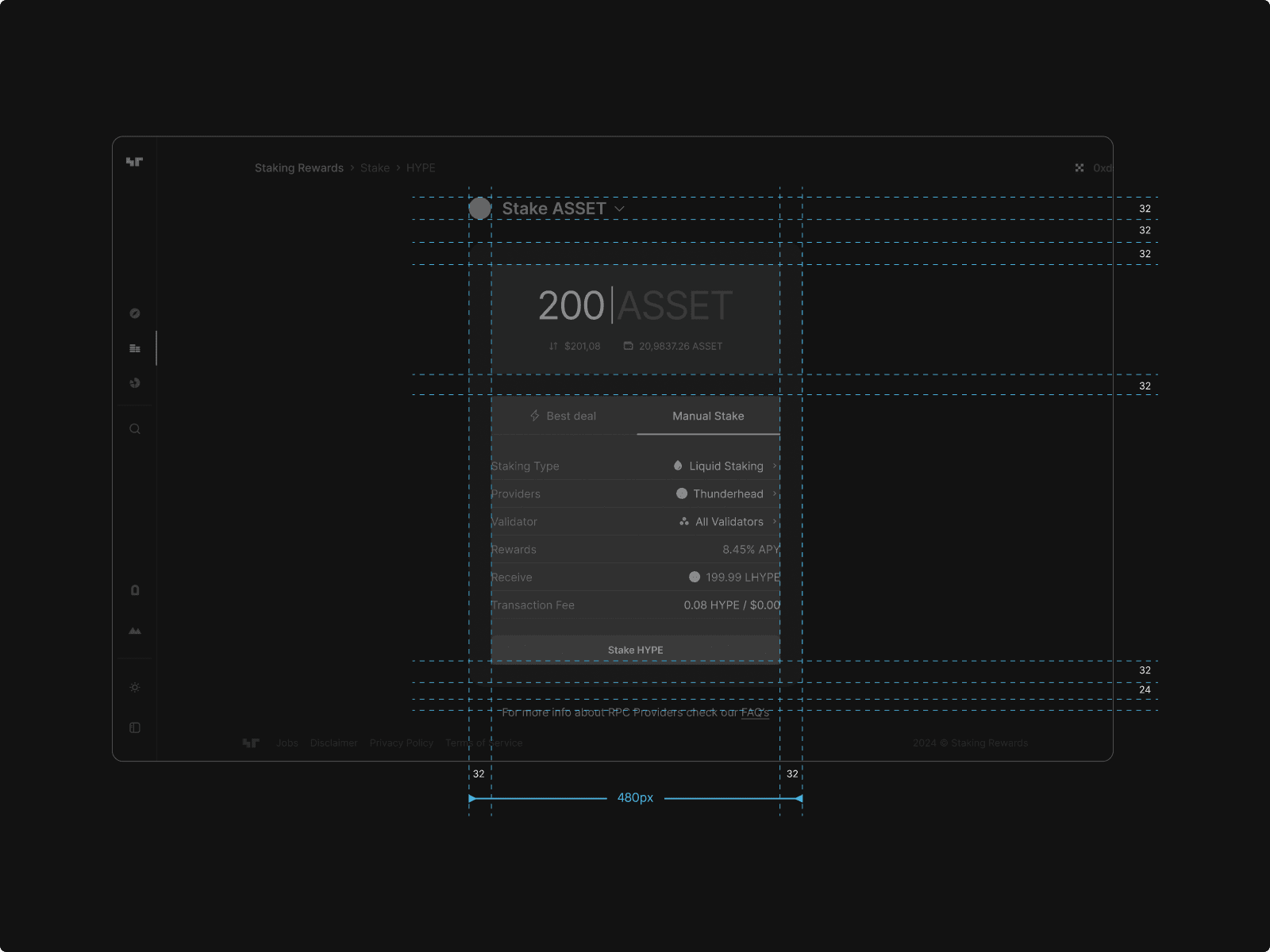
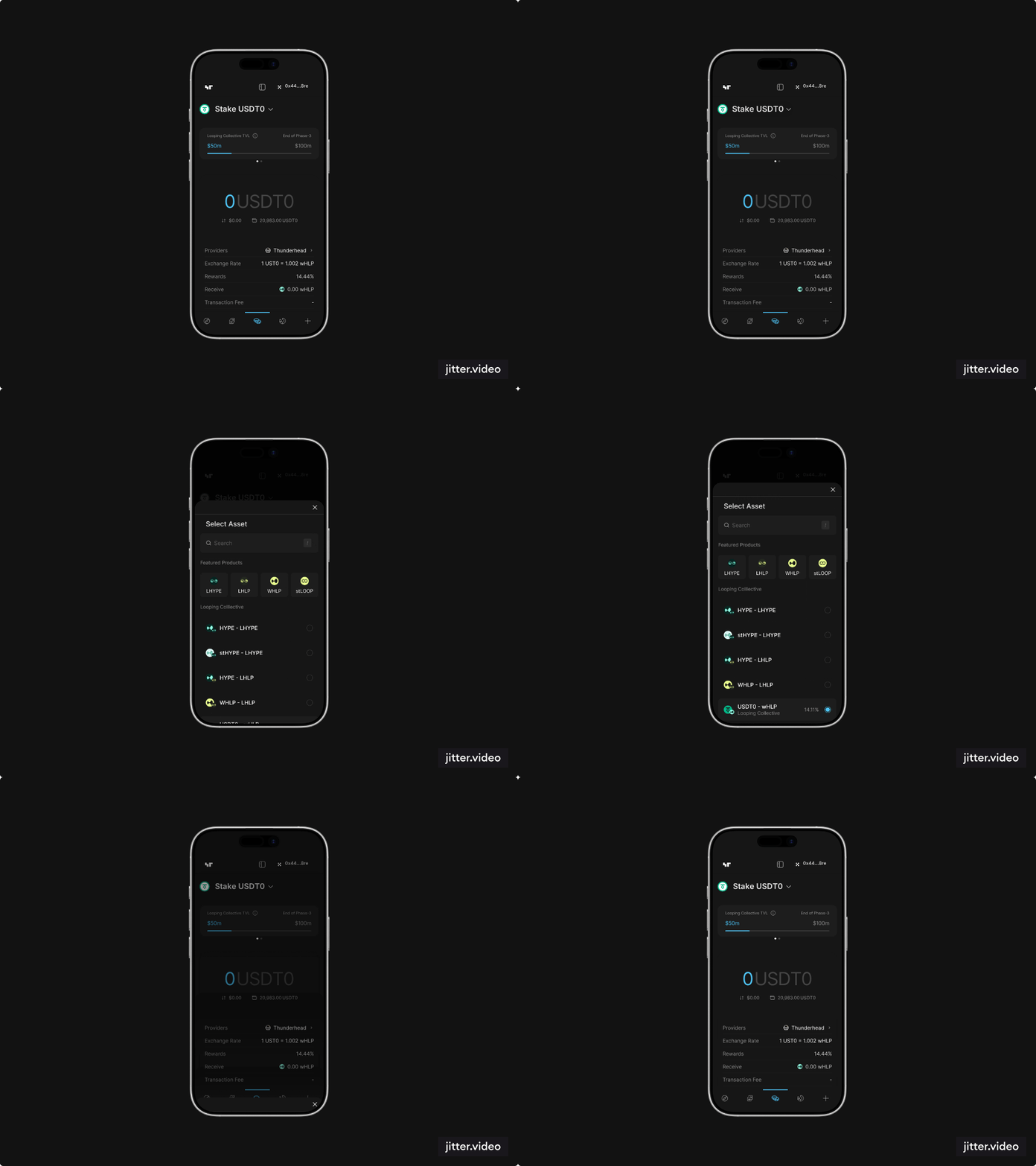
Filtering is treated as an information architecture problem rather than a feature. Controls are structured to remain legible at scale, enabling users to refine datasets without losing orientation. Advanced options are layered deliberately, preserving simplicity at first glance while supporting depth when needed.

RESULTS
The platform expanded significantly without requiring structural resets, maintaining coherence across increasingly complex use cases.
Refined hierarchy and navigation reduced initial drop-off as product surfaces expanded, suggesting improved alignment between user intent and platform structure.
As ratings and verification features were introduced, presentation and methodology clarity contributed to stronger user confidence in the platform’s neutrality and authority.
Improved coherence across product surfaces reduced friction between discovery and action, resulting in higher participation within the staking workflow.
Staking Rewards illustrates the role of design in making complex financial infrastructure usable, trustworthy, and scalable. The work required operating within real constraints, including live users, evolving data models, and continuous product iteration.
By focusing on systems rather than isolated screens, the platform was able to grow without losing coherence or clarity. Design became a stabilizing layer, supporting decision-making for users while enabling internal teams to move faster with confidence. This project reflects my approach to product design in high-stakes environments. I work to align design, data, and engineering into systems that reduce complexity, support long-term growth, and hold up under real-world use.